Tools · Change intelligence
RADAR
Watches AI platform changes and security advisories, and publishes what changed, why it matters and what to do.
Beta public service on a six-hour schedule. Measured precision is not established yet; current pipeline health is under What you can check.
What it is
A scheduled change-intelligence service. It watches AI platform changelogs, pricing, deprecations and security advisories.
It has been publishing since 17 August 2026. The full record, corrections included, is on its own site, along with a written description of how precision is counted and what the numbers do and do not mean.
Why it exists
RADAR aims to explain what changed, why it matters and what to do. Its published items and correction history let readers inspect those explanations; publication alone does not establish correctness.
RADAR is an independent change-intelligence service, not a JCR module or compliance product. A published change can inform a separate review; it does not automatically invalidate, rerun or approve another tool’s evidence.
One loop
How it works
One loop, on a six-hour schedule.
- Step 1
Watch
Fetch the configured watchlist, published on RADAR’s /crawler page.
- Step 2
Detect
Find what changed in a source since it was last read.
- Step 3
Interpret
Write what changed, why it matters and what to do.
- Step 4
Publish
Every item goes out with its source and publication time.
- Step 5
Correct
Corrections are logged publicly, item and edition corrections separately.
Fetching, interpretation and coverage are reported as separate signals. When interpretation is degraded, RADAR says so on its own front page.
Real pixels, dated
Inside RADAR
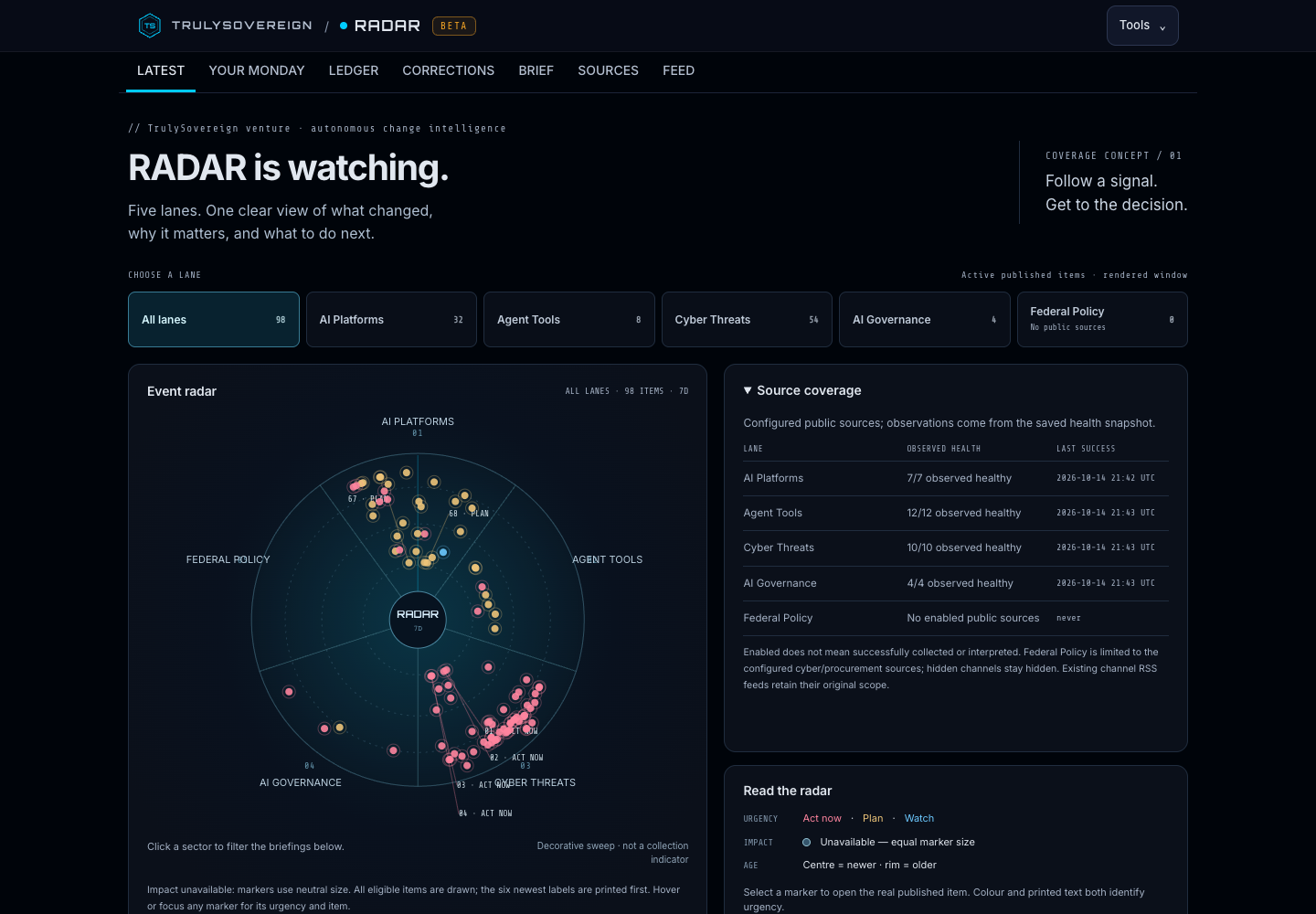
Case study · public intelligence
From provider change to a checkable action.
RADAR watches provider changes and publishes a short interpretation: what changed, why it matters and what to do. Walk through an eligible item from the public feed, then inspect the record yourself.
Explore the workflow
Check current pipeline health →Step 1 · Read the change
Loading the public item record…
What you can check
Live figures come from RADAR’s public feed. A dash means not measured yet.
Beta public service with a scheduled six-hour cadence. Fetching, interpretation and coverage can differ; current pipeline health is shown below. Item corrections, edition corrections and random review progress are separate records. The public random sample was 0/50 on 4 October 2026; measured precision is not established. Open the current record for subsequent progress.
- Cadence
- 6 hScheduled runs, every six hours.
- Publishing since
- 17 Aug 2026Every item, corrections included, is public.
- Sources healthy
- —Loading the live feed…
- Precision
- —Random sample 0/50 as of 4 Oct 2026.
RADAR health at a glance
Loading public health metadata…
- Feed generation
- Unknown — not reported
- Source fetching
- Unknown — no source health reported
- Interpretation
- unknown (reported)
Pending untriaged: Unknown — not reported
Correction history and review progress
Item corrections, edition corrections and random reviews measure different things. Missing counts are unknown. Zero corrections do not establish an error rate, and model confidence is not measured precision.
Full pipeline health, backlog scopes and limits
RADAR pipeline health
Loading public health metadata…
- Feed generation
- Unknown — not reported
- Source fetching
- Unknown — no source health reported
- Latest source fetch success
- Unknown — not reported
- Interpretation
- unknown (reported)
- Queued for interpretation
- Unknown — not reported
- Degraded since
- Unknown — not reported
- Oldest in state backlog
- Unknown — not reported
- Last model-call run
- Unknown — not reported
- Coverage last triage-response run
- Unknown — not reported
- State backlog
- Unknown — state backlog not reported; post-triage work may be invisible
- Coverage window
- Unknown — coverage not reported
“Queued for interpretation” counts unsuppressed changes without a triage verdict, subject to the reported check's grace period. State backlog counts changes by interpretation state, including post-triage work and held changes; stale is an age-based subset, not an additional queue. These scopes differ, may overlap and must not be added together. Missing counts remain unknown.
“Last model-call run” is the run start recorded after at least one triage response, not the latest attempted API call or proof that writing or publication succeeded. Latest attempted call and last successful end-to-end interpretation are not reported in this feed. Unknown values are not zero.
Open source fetching and configured watchlist →What’s real, and what isn’t claimed
Real today
- Public dashboard metadata includes source fetching, interpretation, coverage and run summaries. GitHub Actions verification is internal: the repository is private, so workflow links are not public verification artifacts.
- Every published item is public, with its source and publication time.
- The corrections page separates item corrections from edition corrections. Item correction timing and random-sample reviews have different scopes.
Not claimed
- No accuracy percentage is claimed until the precision sample is complete. The ledger page says how it will be counted.
- The configured watchlist is published on RADAR’s /crawler page and regenerated on each run. Configuration does not prove successful fetching or interpretation of every source.
What gets published
A RADAR item ships only if it answers all three: what changed (the specific, sourced, dated difference), why it matters (who is affected and what breaks) and what to do (a concrete action, or an explicit statement that no action is required). If it cannot, it is suppressed rather than padded.
Precision is counted by random review, and how it is counted is written up before any number is published.
Questions
Where is the correction record?
On RADAR’s own site: the corrections page separates item and edition corrections, and the ledger method explains random reviews. Correction counts alone are not an error rate.
How often does it run?
Scheduled every six hours. A run can fetch sources and regenerate the feed while interpretation is degraded. Public pipeline metadata is shown above; detailed GitHub Actions verification is internal.
Can I subscribe?
Yes, on RADAR’s own site. One email is sent only on days something changed, with one-click unsubscribe and no account. Get the RADAR digest →
Other tools
Undertow
Conversations starting to grow
Explore Undertow PrototypePROBE
Adversarial AI testing, step by step
Explore PROBE Public alphaCCP Study Lab
Learn to investigate a security claim
Explore CCP Study LabDiscuss the evidence you need.
The same discipline behind these tools, applied to your systems.