Tools · Agent-action checkpoint
JCR
JCR is a checkpoint for AI agent actions, in active development. Actions routed through it are checked against policy, then allowed, denied or held for a person to approve, and every decision is recorded as a receipt.
In active development. A hosted runtime runs with private access; the public demo uses synthetic data.
What it is
A routed decision. A receipt you can check.
An agent sends an action to JCR before it runs. JCR checks it against policy, allows it, denies it or holds it for a person to approve, and records a receipt either way. The hosted runtime is private; access is by arrangement.
Why it exists
An agent asks. JCR decides. A receipt records it.
Tell us which agent actions you need to control and what evidence you need to see.
How it works · shown with sample values
How it works
The flow, shown here with sample values.
- Step 1
Intent
An agent proposes an action and routes it to JCR before it runs.
- Step 2
Policy
JCR checks the action against policy.
- Step 3
Decision
The action is allowed, denied or held for a person to approve.
- Step 4
Action
Only a permitted action runs, with the exact inputs that were checked.
- Step 5
Receipt
A receipt records every decision, including denials, in a linked chain.
JCR only sees actions routed through it.
Real pixels, dated
Inside JCR
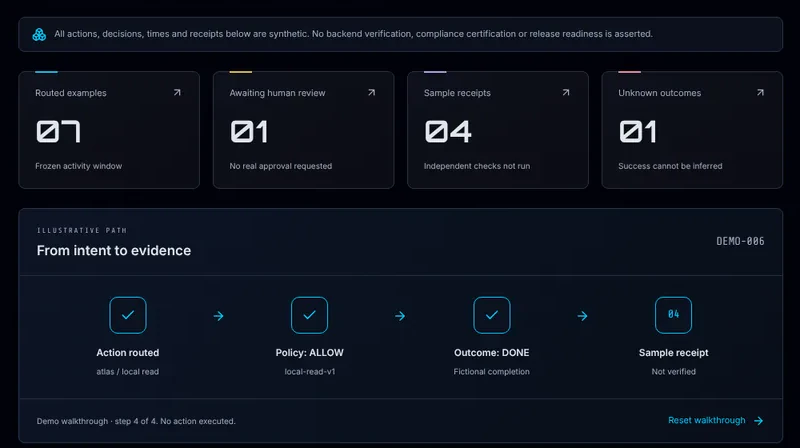
A request, a decision, a receipt.
An agent asks. JCR decides. A receipt records it.
- Step 1
An agent proposes an action
An agent proposes an action.
- Step 2
Routed to the JCR checkpoint
The agent routes it to JCR before it runs.
- Step 3
Policy check
JCR checks the action against policy.
- Step 4
Decision
The action is allowed, denied or held for a person to approve.
- Allowed: It runs with the exact inputs that were checked.
- Denied: The action stops and the tool is never touched. The denial still gets a receipt.
- Held for a person to approve: It waits for a person. It runs only once a person approves it.
- Step 5
A person approves (held case)
A held action waits for a person. Once a person approves it, it runs. Only a permitted action runs, with the exact inputs that were checked.
- Not approved: it does not run.
- Step 6
Receipt recorded
A receipt records every decision, including denials.
- Allowed: receipt DEMO-R006 (sample)
- Denied: receipt DEMO-R005 (sample)
- Held for a person to approve: receipt DEMO-R007 (sample)
- Step 7
Receipt chain
Receipts form a linked chain: each new receipt’s prev holds the hash of the receipt before it.
- Sample link: prev SAMPLE_HASH_PREV_NOT_REAL = hash of demo-previous-006
- Step 8
Only routed actions
JCR only sees actions routed through it. An agent with its own credentials or network access can act without JCR, and JCR will not know. It does not detect every use of AI across a company.
Sample identifiers and placeholder hashes. Nothing here is computed, and nothing is connected to a runtime.
What you can check
A dash means not measured, not zero.
- Public demo
- OpenSynthetic actions, sample receipts
- Hosted runtime
- Private accessRunning; not open for sign-up
- Public sample evidence pack
- —Not published yet
- Security and release acceptance
- —Dated scoped reviews do not establish full acceptance
What’s real, and what isn’t claimed
Recorded implementation scope
Private implementation records and scoped reviews are dated evidence, not a current release-acceptance verdict. The public demo is synthetic.
- A hosted JCR runtime is running, with private access. It is not open for public sign-up.
- MCP gateway: an agent that uses the Model Context Protocol, such as a coding assistant, can be pointed at JCR instead of its tool server without changing the agent. Each tool call is then checked and run, denied or held for approval, with a receipt.
- Agent registry: an agent JCR does not know is refused, and the refusal is recorded.
- Agent-reach map: for each agent, what it is allowed to do and what it has actually done, read from its receipts.
- Evidence packs: an export of receipts and the policies they cite, designed to be checked offline on a separate computer without relying on the operator’s server. Receipt chains are also timestamped by an outside timestamp service.
- Incident reconstruction: given an incident time, the evidence is indexed by one rule’s clauses, with the reporting deadline worked out. The first profile covers a 72-hour incident-reporting rule.
- The public demo: synthetic actions, policy decisions and sample receipts you can open and inspect.
Not claimed
- JCR only sees actions routed through it. An agent with its own credentials or network access can act without JCR, and JCR will not know. It does not detect every use of AI across a company.
- The receipts on this page and in the public demo are synthetic samples. No public sample evidence pack has been published yet.
- Dated independent reviews cover specific versions and paths; they do not establish complete security or release acceptance. JCR is not a compliance certification, and a receipt does not prove the model or the policy was right.
- The hosted runtime is not a public service: there is no self-serve sign-up, pricing or service level.
The stack
Separate tools, each with its own job and status. A family of work, not an implemented integrated platform.
JCR, RADAR, PROBE and FARADAY are related independent tools. FARADAY asks where a model runs; JCR asks what an agent was allowed to do.
Other tools
PROBE
Adversarial AI testing, step by step
Explore PROBE ResearchFARADAY
AI on hardware you control
Explore FARADAY BetaRADAR
AI platform changes, explained, with corrections
Explore RADARDiscuss the evidence you need.
The same discipline behind these tools, applied to your systems.